Thinking about recessed lighting for your home or commercial space? This guide covers what you absolutely need to know about fire hoods, fire-rated downlights, and whether you’re legally or practically required to use them. Here's what you'll learn in this article:
-
Why cutting holes in ceilings for recessed lights poses serious fire safety risks
-
What fire-rated downlights are and how they protect your ceiling’s fire integrity
-
When and where fire hoods are necessary — and when they’re not
-
Key building regulations (including Part B) that apply to your installation
-
The best alternatives to fire hoods if your downlights are already fire-rated
-
What type of ceiling structures and floors require enhanced fire resistance
-
Real-world product options from LED Network
By the end of this article, you'll know exactly what’s needed to stay compliant, safe, and confident in your recessed lighting installation — whether you're outfitting a residential ceiling or a multi-story commercial space.
Why Recessed Lighting Poses a Hidden Fire Risk
Installing recessed downlights has become standard in modern lighting design — they’re sleek, subtle, and highly functional. But what most homeowners and even some contractors don’t realize is this:
Every ceiling cut-out for a recessed light compromises the fire barrier of your ceiling.
That’s not just a minor inconvenience — it can be a serious fire hazard if not addressed properly.
Your average plasterboard ceiling is naturally fire resistant. However, once you cut into it to install a recessed fitting, you’re creating a direct path for flames and smoke to spread rapidly in the event of a fire. If you’ve got occupants above, such as in a multi-story home or an apartment, that breach could cost crucial escape time.
This is where fire-rated downlights and fire hoods come in.
What Is a Fire Hood (and Is It Always Required)?
A fire hood is a heat-resistant enclosure that fits over the back of a non-fire-rated recessed light. Its job? To restore the fire protection that was lost when the ceiling was punctured. It’s a passive fire protection system, designed to slow the spread of fire and preserve the fire rating of the ceiling for a designated period — often 30, 60, or 90 minutes, depending on the building structure and local code requirements.
But here’s the kicker:
If you’re using fire-rated downlights, you typically don’t need a separate fire hood.
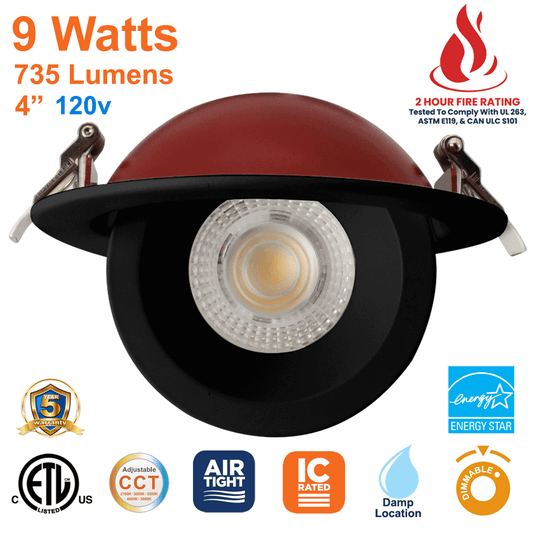
For instance, our popular 4-Inch Fire Rated Pot Light (2-Hour Fire Rating) already includes an integrated intumescent pad, which swells and seals the cut-out if exposed to heat. That eliminates the need for any additional fire hood accessory.
So, do you always need fire hoods? Not necessarily. If your fixture isn’t fire-rated as standard, then yes — a fire hood or retrofit protection like a loft cap is strongly advised or even required by code.
What Does “Fire Rated” Really Mean?
A fire-rated downlight is a recessed lighting fixture specifically engineered to maintain the fire resistance of the ceiling where it’s installed. In practical terms, this means:
-
It contains a built-in intumescent material that expands when exposed to high heat
-
It seals the ceiling cut-out to prevent flames and hot gases from spreading upward
-
It’s tested and certified to resist fire for 30, 60, 90, or even 120 minutes
-
It meets Part B of the Building Regulations, which govern fire safety in construction
Take for example the compact and efficient 3-Inch Fire Rated Pot Light. It's fully compliant with UL 263, has a 2-hour fire rating, and is ETL certified — making it an ideal solution for tight ceiling spaces that require full fire protection without needing a separate hood.
When Are Fire-Rated Downlights or Fire Hoods Required?
While every installation is different, you’ll typically need fire protection in the following scenarios:
1. When There Are Living Spaces Above
Any ceiling beneath a habitable floor — whether it’s a bedroom, bathroom, or landing — requires either a fire-rated fitting or an approved fire hood to restore fire integrity.
2. In Multi-Story Residential or Commercial Buildings
Even more essential in multi-unit dwellings or offices where building inspectors will look for fire compartmentation and safety compliance.
3. When Specified by Building Regulations
For both residential and commercial projects, Part B of the Building Regulations is the section covering fire safety. It’s split into:
-
Volume 1 – for domestic dwellings
-
Volume 2 – for non-domestic/commercial buildings
Most fire-rated pot lights sold by LED Network are tested and certified to comply with these standards, helping ensure both safety and code compliance without the need for add-ons.
Installation Scenarios That Affect Fire Rating Needs
Every building is different, but here are some common ceiling configurations that impact whether you’ll need a fire hood or fire-rated fixture:
| Ceiling Type | Description | Typical Fire Rating Needed |
|---|---|---|
| Plasterboard (12.5mm) | Single board with 600mm joist spacing | 30 minutes |
| Double Plasterboard (15mm) | For added protection between floors | 60 minutes |
| Double with 450mm Joist Spacing | Heavier-duty structure | 90 minutes or more |
| Concrete Slab & Suspended Ceiling | Often exempt from fire rating | 0 minutes or case-specific |
If your ceiling has thermal insulation, it’s also essential to ensure your fixture is insulation coverable or use a product like the 6-Inch Fire Rated Pot Light, which is IC rated for direct contact with insulation.
The Difference Between Fire-Rated and Non-Fire-Rated Downlights
Not all downlights are created equal. Many people assume LED lights don’t get hot, so they can't possibly be a fire risk. But that’s a dangerous misconception.
Even though LED safety standards have improved dramatically, cutting a hole in your ceiling for a recessed fitting still weakens the fire barrier, regardless of how cool the LED runs. This is especially important when dealing with combustible materials like wooden joists or insulation above the ceiling.
So, how do fire-rated downlights differ?
Fire-Rated Downlights:
-
Designed to restore the fire rating of a ceiling
-
Contain an intumescent pad that expands under extreme heat to seal the cut-out
-
Undergo rigorous testing (often UL 263 or BS 476) for fire resistance
-
Usually rated for 30, 60, 90 or 120 minutes
-
Provide peace of mind for home improvement projects that need code compliance
Non-Fire-Rated Downlights:
-
Lack built-in fire protection
-
May require external fire hoods or insulation boxes
-
Not compliant with fire safety requirements in multi-storey or occupied floor applications
-
Generally less expensive, but risk non-compliance with Building Regulations
When selecting a fixture, always consider your ceiling structure, whether it's in a residential ceiling or commercial ceilings, and your joist spacing. If you're unsure, it's best to opt for a certified product — or ask your installer about local compliance requirements.
Fire Hoods as a Retrofit Solution
Let’s say you’ve already installed non-fire-rated downlights and removing them isn’t an option. You’re not out of luck — this is where fire hoods come in.
These accessories are installed above the fitting, essentially creating a sealed enclosure that contains heat and smoke in the event of a fire. A fire hood accessory can help you:
-
Comply with Part B of the Building Regulations
-
Protect ceiling integrity in spaces with living areas above
-
Prevent fire spread through weak points in the ceiling
-
Retain aesthetic or functional lighting that wasn’t fire-rated as standard
Note: Not all fire hoods are created equal. Make sure the product you choose meets certification standards and is compatible with your light fittings.
While fire-rated downlights offer a cleaner and more integrated solution, fire hoods are still a valid option for lighting retrofits — especially in older buildings where updating the ceiling infrastructure may be costly.
What Happens If You Don’t Use Fire-Rated Lighting or Hoods?
Ignoring fire safety in your lighting installation isn’t just risky — it can be legally problematic and potentially life-threatening.
Here's what could happen if you skip it:
-
Rapid fire spread through the recessed light cut-outs
-
Failure to meet building inspection criteria
-
Voided insurance claims in the event of a fire
-
Required rework and additional cost to meet code compliance
-
Reduced resale value of the property if not up to fire safety standards
Fire-rated fittings, or at minimum, fire hoods, are not optional in most regulated construction environments. Even in jurisdictions where they’re not strictly required, they are strongly recommended — especially in high-risk areas like bathrooms, hallways, or under loft spaces.
Can Insulation Touch Downlights?
This is a common — and important — question.
Can insulation touch downlights?
The answer: only if they’re IC-rated or designed to be insulation coverable.
Why? Because non-IC rated fittings can overheat when surrounded by insulation. This heat can:
-
Increase fire risk
-
Shorten the life of your LED driver
-
Violate Part L of the Building Regulations related to thermal protection
Fortunately, LED Network carries a selection of IC-rated fire-rated downlights, which are tested to ensure safe performance even when surrounded by insulation materials. Many of our customers choose these fittings to make installations faster, safer, and code-compliant from the start — no need for extra accessories like loft lids or insulation boxes.
Look for Key Certifications and Features
When evaluating your downlight options, here are some terms and marks that indicate fire safety and electrical compliance:
-
UL 263 or BS 476 Part 21/23 – Fire rating certifications
-
ETL/Intertek or cETL – North American safety testing
-
IC-rated – Safe to be in contact with insulation
-
F-Mark – Safe for mounting on normally flammable surfaces (note: not a fire rating)
-
CE marking – Indicates EU safety compliance
Always verify the fire rating of the fixture — for example, 30, 60, 90 or 120 minutes — based on your specific application. If in doubt, your installer or a building inspector can help determine what's appropriate for your space.
How to Choose the Right Fire Rating (30/60/90/120 Minutes)
One of the most overlooked details when selecting recessed lights is the fire rating duration. Not all fixtures are equal, and the level of fire resistance required depends on the ceiling type, number of floors, and local code enforcement.
Here’s a quick breakdown of what each rating typically corresponds to:
| Fire Rating | Application |
|---|---|
| 30 minutes | Ground floors in houses or rooms with minimal occupancy above |
| 60 minutes | Between floors in standard two-storey homes or apartments |
| 90 minutes | Ceilings below high occupancy rooms, like flats or office spaces |
| 120 minutes | Ceilings in multi-storey commercial or dense residential buildings |
For example, our 2-hour fire rated pot lights are specifically designed to handle high-risk installations — giving you peace of mind in complex building environments.
If you’re ever uncertain, defaulting to a higher fire rating is a good way to future-proof your installation, especially if you’re planning a home renovation or aiming to meet upcoming lighting regulation updates.
Matching the Right Fire-Rated Pot Light to Your Space
Different rooms have different demands — both in terms of lighting function and fire risk.
Here’s a practical guide for selecting the right fire-rated downlight from LED Network, based on room type:
1. Bathrooms & Kitchens
These rooms require wet-rated, IC-rated, and preferably insulation coverable lights.
-
Ideal Choice: 4" Fire Rated Pot Light – Wet Rated
-
Why? Fully sealed for moisture protection and 2-hour fire rating
2. Living Rooms & Bedrooms (Lower Floors)
Ceilings with occupants above must restore the fire integrity of the ceiling.
-
Ideal Choice: 6" Fire Rated Pot Light – High Lumen Output
-
Why? Excellent lumen output, IC-rated, and compliant for most residential ceilings
3. Tight Spaces, Hallways, or Decorative Layouts
Smaller fittings are often needed in compact or stylish applications.
-
Ideal Choice: 3" Fire Rated Downlight – Compact Design
-
Why? Space-saving, still meets 2-hour UL263 fire safety rating
Final Thoughts: Are Fire Hoods Still Relevant?
In 2025 and beyond, the use of fire-rated downlights has become so widespread and affordable that fire hoods are now largely a secondary option — useful mainly for:
-
Retrofit scenarios where fixtures are already installed
-
Design-led projects where the chosen downlight is not available as fire-rated
-
Cost-saving compromises, though not always advisable for long-term compliance
That said, fire hoods still serve a purpose. When paired with non-fire-rated downlights, they can help you meet inspection standards, maintain ceiling structure protection, and limit fire spread through weakened areas of the ceiling.
Bottom line: If you’re starting from scratch — go with integrated fire-rated downlights. They’re cleaner, safer, and engineered for the way buildings are designed today.
Your Practical Checklist for Choosing Safe, Compliant Downlights
Before wrapping up your lighting installation, run through this quick checklist to ensure you’re on the right track:
-
Are there living spaces above the ceiling?
-
Have you verified your ceiling’s construction and required fire rating?
-
Are your downlights fire-rated to 30/60/90/120 minutes?
-
Do your fixtures include IC ratings if surrounded by insulation?
-
Are the products certified (e.g., UL 263, ETL, CE marking)?
-
Do you need a fire hood accessory for any non-fire-rated fixtures?
-
Is your installation aligned with Part B of the Building Regulations?
Why Choose LED Network for Fire-Rated Lighting?
At LED Network, we specialize in fire-rated pot lights engineered for Canadian and North American homes and commercial spaces. All our products are:
-
Tested to national fire safety standards
-
IC-rated and wet-rated for safe, versatile installations
-
Designed with 5CCT selectable lighting for maximum flexibility
-
Backed by reliable warranty and certification documentation
We’re not just a lighting store — we’re a single-brand supplier focused on fire-safe lighting solutions that work in real-world homes and buildings.
Final Word
The question "Do You Need Fire Hoods for Recessed Downlights When and Why" ultimately boils down to one thing: protecting life and property while staying compliant with modern fire safety standards.
And while fire hoods still serve a purpose, the smarter move — especially in new builds or upgrades — is to go with certified, fire-rated downlights from the start. You’ll save time, money, and possibly lives.
Need help choosing the right product for your next project?
Explore our full Fire-Rated Pot Light Collection or reach out to our support team today.
FAQ: Fire Hoods and Fire-Rated Downlights
1. Are fire hoods and fire-rated downlights the same thing?
No. Fire-rated downlights have built-in fire protection mechanisms (typically intumescent pads), whereas fire hoods are external accessories used to add fire resistance to non-fire-rated downlights. Think of a fire-rated fitting as an all-in-one solution, and a fire hood as a retrofit workaround.
2. Can I install fire hoods myself, or do I need an electrician?
While it’s technically possible to install a fire hood yourself, it’s strongly recommended to hire a qualified electrician. Improper installation can void compliance, compromise safety, and even interfere with ventilation and heat dissipation.
3. Do I need fire hoods for LED lights if they produce less heat?
Yes — heat output is not the determining factor. The fire risk comes from cutting into the ceiling, not from the LED itself. Even low-heat LEDs can allow flames and smoke to bypass your ceiling’s fire barrier if they’re not fire-rated or fitted with a fire hood.
4. Do fire hoods affect the performance of downlights?
When installed correctly, high-quality fire hoods should not impact light output or longevity. However, poor-quality hoods or improper installation can lead to overheating, reduced efficiency, or failure of the light fitting over time.
5. Are fire hoods reusable if I change the light fitting?
Usually not. Once a fire hood has been removed or tampered with, its original shape and integrity may be compromised, which could make it non-compliant. Always check the manufacturer’s guidance and local fire safety codes before reuse.
6. Is a fire hood required if I’m installing lights in a garage or utility room?
It depends. If the ceiling beneath the garage or utility room is below a habitable space (e.g. a bedroom), you’ll likely need fire-rated protection. If it’s a standalone, single-storey structure with no occupancy above, it may not be required — but always check local building codes.
7. How do I know if my current downlights are fire-rated?
Look for certification labels such as UL 263, BS 476, ETL, or CE markings on the fixture or packaging. If it mentions a specific fire resistance duration (e.g. 30, 60, or 90 minutes), then it’s fire-rated. If there’s no mention of fire performance, assume it’s not.
8. Do fire hoods need to be tested or certified?
Yes. Fire hoods must meet specific fire resistance testing standards, often aligning with BS EN 1363, BS 476, or UL 263. Always buy from reputable sources to ensure your fire hood has undergone the necessary safety testing.
9. Can fire hoods be used with dimmable downlights?
Yes — as long as the fire hood is compatible with the downlight model and installed according to manufacturer instructions. Dimming functionality won’t be affected, but ventilation and space constraints need to be considered to prevent overheating.
10. Do I need fire hoods for surface-mounted or track lights?
No. Fire hoods are only required for recessed downlights, which involve cutting into the ceiling and compromising its fire barrier. Surface-mounted or track lights do not breach the ceiling and do not require fire protection accessories.